
[引用はこちら/Reference]
Zhuoli Wang, Yuta Sugiura, Gait analysis on daily data using IMUs in smart phones, watch and earbuds, Gait & Posture, Volume 123, 2026, 109969, ISSN 0966-6362. [DOI]
背景(Background):慣性計測ユニット(IMU)センサを用いた歩行解析は、近年ますます注目を集めている。ウェアラブルスマートデバイスやスマートフォンの発展に伴い、日常生活における動作データを低コストで取得できる環境が整いつつあり、従来の制御された実験室環境に依存した解析手法の制約を補完する可能性を有している。しかしながら、これらの技術的潜在性にもかかわらず、日常生活環境における歩行データの解析には依然として多くの課題が存在する。
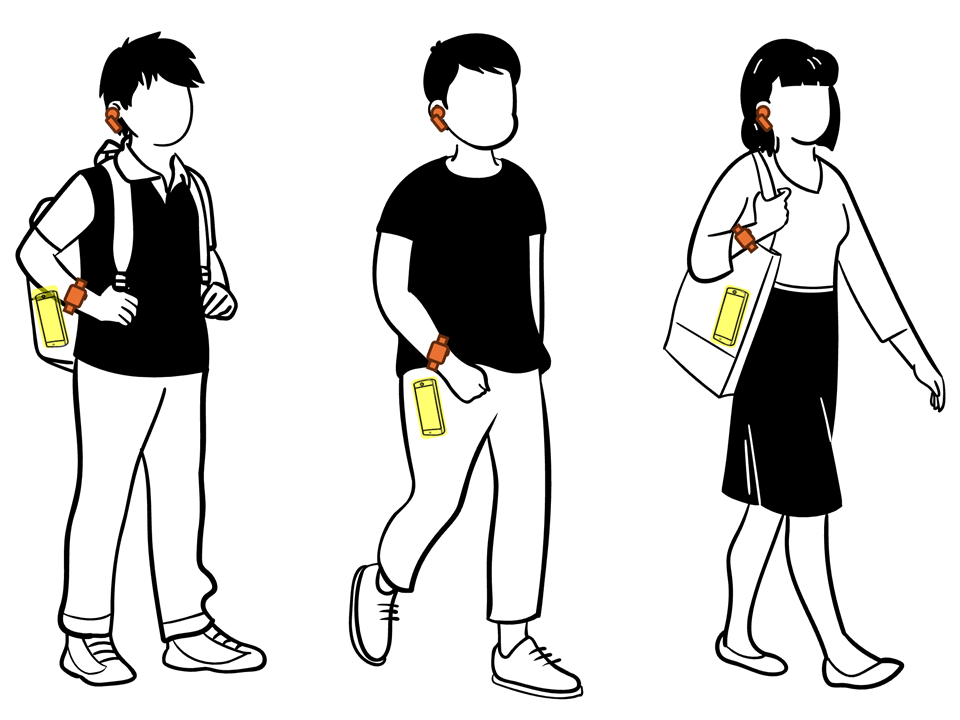
手法(Method):本研究では、16名の被験者(女性7名、男性9名、平均年齢27.69歳)を対象に、歩行、走行、階段昇降の動作を、スマートフォンの携帯位置(ポケット、バックパック、ショルダーバッグ)の3条件下で実施した。データ取得には、iPhone 14、Apple Watch Series 10、AirPods Pro を用い、グラウンドトゥルースとして Xsens モーションキャプチャシステムを併用した。加速度および角速度からなるIMUデータに対して前処理および標準化を行った後、主成分分析(PCA)を適用した。さらに、連続性と一致度の双方を評価する Continuity-Matching Score(CMS)を導入したスライディングウィンドウ型アルゴリズムを提案し、歩行の分割およびグルーピングを行った。
結果(Result):提案手法は全体で89.25%の歩行分割精度を達成し、スマートフォンをポケットに携帯した条件において最も高い性能(90.38%)を示した。Rand Index による評価から、歩行グルーピングの信頼性も確認され、バックパックのような動的な携帯条件下ではわずかな精度低下が見られた。歩行のみのデータセットでは分割精度が95.67%に向上し、走行のみのデータセットでは96.21%の精度が得られた。
結論(Conclusion):本研究では、一般消費者向けデバイスに搭載されたIMUセンサを用いた日常生活環境下の歩行解析システムを提案した。提案アルゴリズムは、複数の歩行様式を含むデータに対しても安定した歩行分割および同期歩行のグルーピングを実現できることを示した。今後は、より動的な環境への適応性の向上や、より大規模かつ多様なデータセットへの適用を目指す。
Method: Experiments involved 16 participants (7 women, 9 men; mean age: 27.69 years) who performed walking, jogging, and going up and down stairs under three smartphone-carrying conditions: pocket, backpack, and shoulder bag. Data were collected using iPhone 14, Apple Watch Series 10, and AirPods Pro, supplemented with Xsens motion capture for ground truth. IMU data from accelerometers and gyroscopes were preprocessed and standardized before applying Principal Component Analysis (PCA). A novel sliding window-based algorithm was developed for gait segmentation and grouping, featuring a Continuity-Matching Score (CMS) for evaluating both continuity and match quality.
Result: The proposed algorithm achieved an overall segmentation accuracy of 89.25%, with the highest performance (90.38%) observed when the smartphone was carried in a pocket. Rand Index values confirmed reliable gait grouping, with minor accuracy reductions under more dynamic carrying conditions, such as backpacks. For walk-only dataset, segmentation accuracy improved to 95.67%, while for run-only dataset, the accuracy reached 96.21%.
Conclusion: This study introduced a system for daily-life gait analysis using consumer-grade IMU-equipped devices. The algorithm is capable of handling data containing multiple gait types, achieving reliable segmentation and grouping of synchronous gaits. Future work will focus on enhancing algorithm adaptability to dynamic environments and expanding its applicability to larger and more diverse datasets.